Saint Michael

On September 29th, we honor Saint Michael and celebrate on this day his bravery as he is known for having fought evil and the dark angels.

Battle of Angels

The book of Revelation tells us in detail:


Michael depicted as a soldier conquering the dragon.
Fig.1 – Michael as a soldier conquering the dragon. Foto credit https://revelationjesuschrist.org


“There was a great battle in the heavens. Saint Michael and his angels fought against the Dragon. The Dragon and his angels also fought, but they did not prevail and there was no longer a place in Heaven for them.  And the Dragon, the ancient Serpent, the so-called Devil and Satan, the seducer of the whole world, was thrown out; He was thrown to the earth and his angels with him.”  ~Revelation 12:7-9

Saint Michael, a soldier
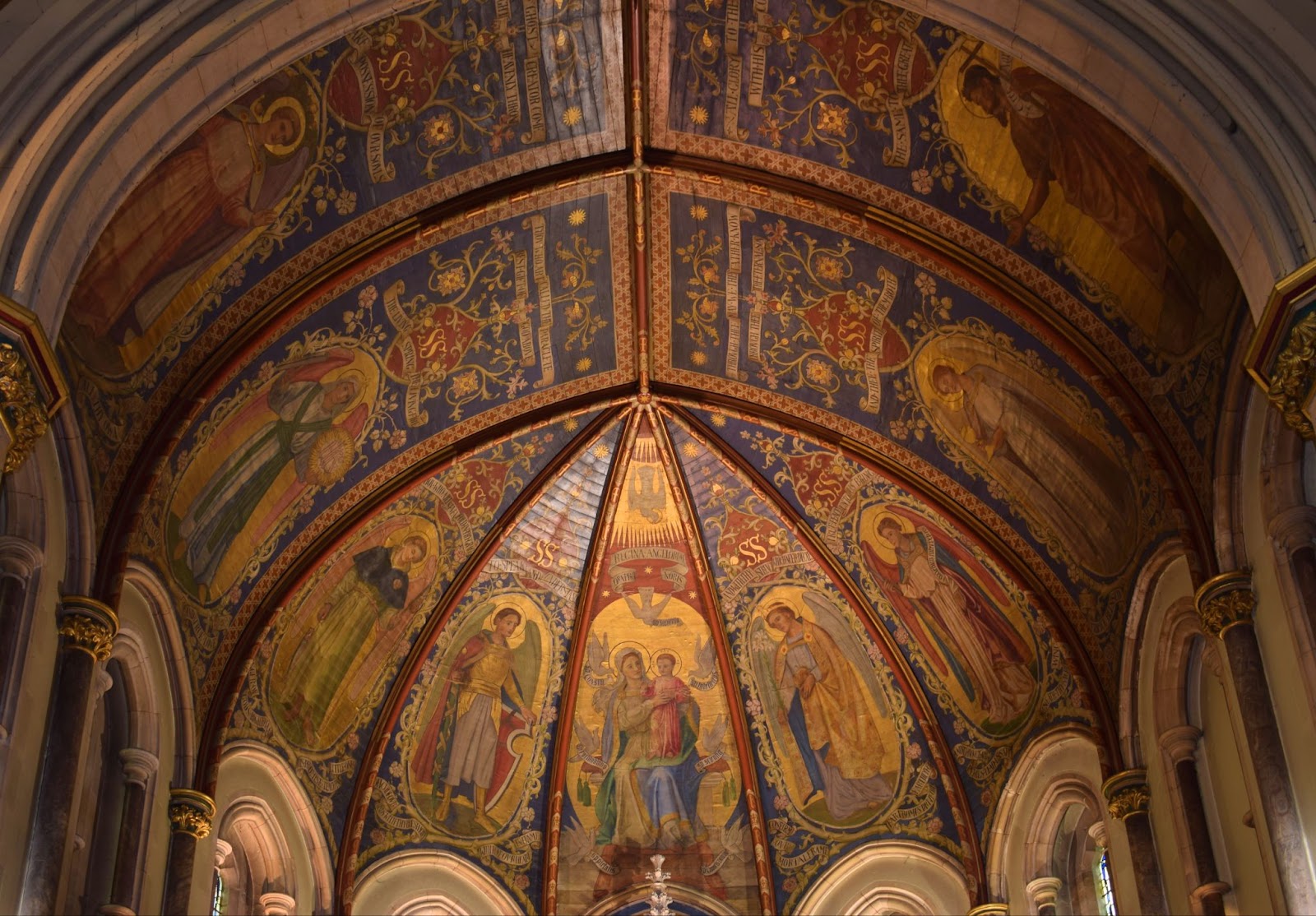
Holy Ghost Catholic Church in Basingstoke, England.
Fig. 2 – Holy Ghost Catholic Church in Basingstoke, England. Foto credit: loandbeholdbible.com


Again as in Fig.1, Saint Michael is depicted as an angel in armor fighting a dragon with a sword. In figures 2 and 3, Saint Michael is part of a scene of all seven archangels, on the sanctuary ceiling of Holy Ghost Catholic Church, in Basingstoke, England.

In a close up in Fig.2, from the overall sanctuary scene, Saint Michael is shown as a military man, with a sword and shield. He shows in the center, next to the Madonna and Child, given his special place within the archangels. He is a warrior, a savior, a soldier, who gives us an example of great courage and bravery.
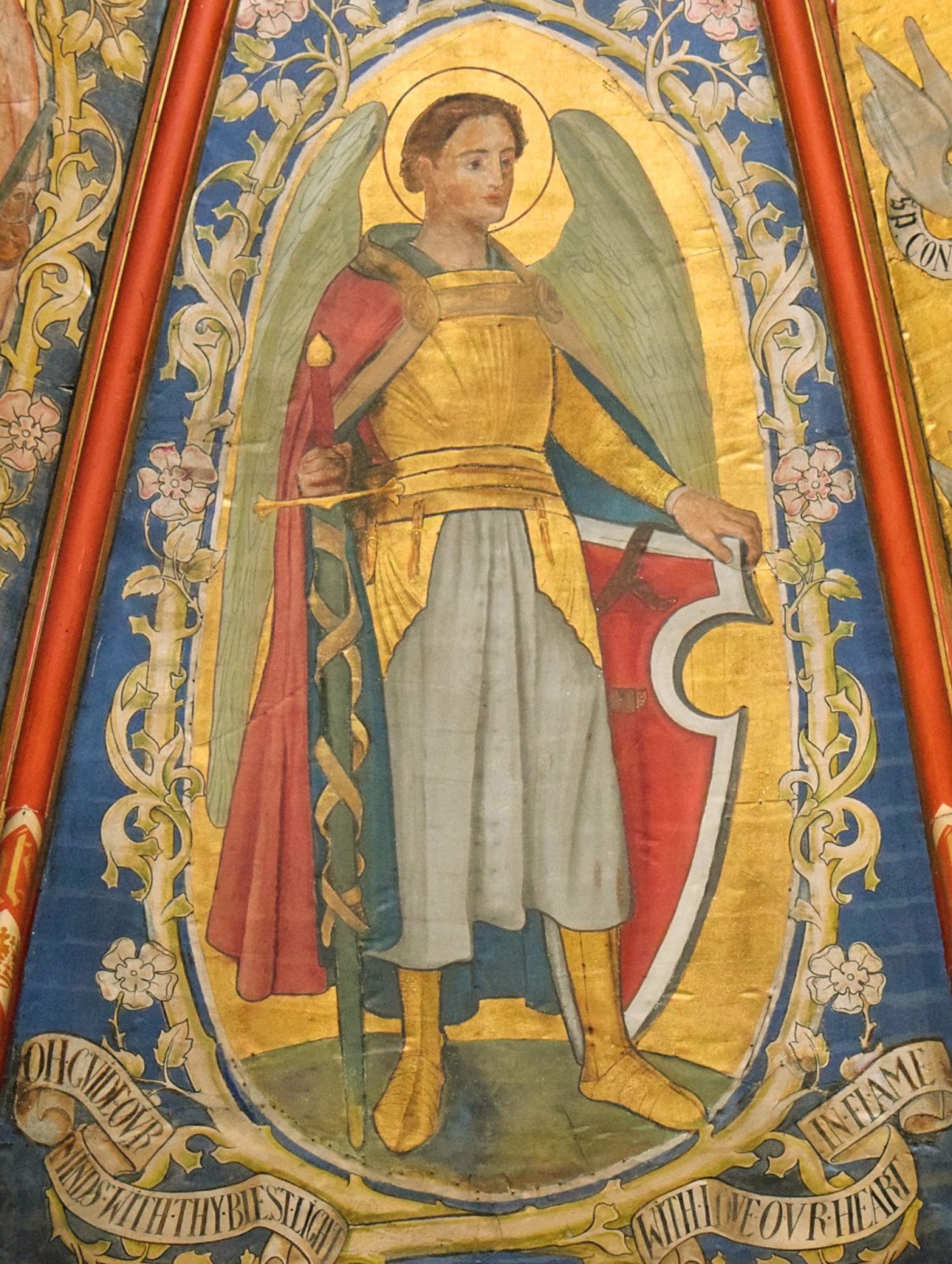
Nathaniel Westlake / St Michael the Archangel / Marouflage mural / Date unknown
Fig. 3 – Nathaniel Westlake / St Michael the Archangel / Marouflage mural / Date unknown Foto credit: loandbeholdbible.com


Historical celebration

Going back to ancient times, the archangel Saint Michael’s day was one of the main christian celebrations. Saint Michael and his angels were given their own feast day by Pope Gelasius in AD 487.  This became an important day, almost marking the end of the harvest and the beginning of another farming cycle.

Equally important, it became a time in England when new servants were hired, debts were paid and land was exchanged. Furthermore, Michaelmas was such a crucial time that it became a date in which magistrates were elected. Likewise, it marked the beginning of legal and university periods.

Waldorf Schools celebration

Michael is fighting a dragon from an imaginative story in Waldorf Schools

In Waldorf schools, Saint Michael is brought up in an imaginative story where Michael comes to save with his powerful sword a town which is pestered by a dragon. In some stories, the dragon is feeding from the harvest that civilians gather; in other stories, the dragon is attacking and frightening the town. Regardless of the story development, Saint Michael comes to bring peace and conquers the dragon. In Saint Michael’s day, Waldorf schools have plays performed and verses recited celebrating such an occasion. Moreover, schools plan a special time during the Michaelmas celebration for the children to go through fun bravery challenges to find courage in times of difficulty.

Equinox

The time of Michaelmas happens to fall on a day close to the equinox. It is a date when the days start getting darker. Hence, we call upon our strength to sustain the darkness of the winter days in the northern hemisphere. There are three months apart from the solstice in which Saint John’s festival is celebrated and three months apart from the festival of Christmas or around the shortest day of the year.

Why is Michaelmas important?

Saint Michael’s day was not being celebrated in modern times. It passed to be an ancient christian day, until Rudolf Steiner suggested the celebration of Michaelmas. Why is this festival important more so in modern times than it was needed in ancient times? As Steiner suggested: “with the rise of the intellect and modern technologies, the coldness has entered our hearts too”. Our civilization is in need of spiritual connection, an awakening of spiritual values.

Michael’s message

The message of Saint Michael is to fight evil forces that take us away from true values and from spiritual growth. As Charles Kovacs states in his book ~ The Spiritual Background of Christian Festivals~: “The materialistic civilization in which we live has done everything possible to convince us that there is only the physical sense world, and that in it there is no divine wisdom and no meaning.” 

Michael’s name meaning

The name Michael means “Who is like God?”. The message behind his name is interpreted to be closer to God. It is a call to humanity to awaken our own spiritual nature. It is a time to be reminded of our own likeness to the Creator and of our strength and power to create light and to fight darkness, to make the world a place with less destruction and a closer relation to our true nature, our God like nature. It is our time to be brave and strong to grow our creative nature and our God-like values. 

Happy Michaelmas!


Mixed Grades 2-3

Mixed Grade 2-3 combines the curriculum for grade 2 and 3 in a smooth way blending both curriculums in 10 blocks throughout the year.


Block Rotation and Class Schedule

Below is the block rotation for the school year and the class schedule:

[integrate_google_drive id=”23″]


Overview Objectives and Suggestions

Additionally you may review and Overview of Suggestions and Objectives for the Grade 2-3:

[integrate_google_drive id=”29″]


Blocks

In the following links, blocks would be available before each block date for 45 days once posted:

Mixed Grade 2-3 Block 1 – Mathematics

Mixed Grade 2-3 Block 2 – Language

Mixed Grade 2-3 Block 3 – Math

Mixed Grade 2-3 Block 4 – Language

Learning from our surroundings

The 9-year old change

Learning from our surroundings is a core method in Waldorf Education. In the first years of childhood, Education focuses on learning from imaginative stories and the contact with the natural world. By the time third grade is reached, the child goes through an important developmental phase, the Rubicon or an awareness of a more detached form of existence. As Rudolf Steiner explained:

“At the moment around the age of nine when the Self awakens, the human being separates himself from his natural surroundings, and is now on the way to being able to make objective comparisons between natural phenomena.” (Steiner 1998, p. 173)

The Rubicon

In Ancient history, the Rubicon was the river that separated the Italian heartland from the Roman Province of Gaul. In the year 49 BC, Julius Caesar crossed the Rubicon with his army in spite of the opposition of the senate, which had the connotation of being an irreversible action. Due to this important step during the Roman Empire, Steiner used this event as a metaphor to explain the crucial step on child development. Caesar iconized this ‘no point of return’ statement with the words: “alea iacta est” (“The die is cast”).

Caesar crossing the Rubicon, 49 BC
Image 
Credit: Lanmas / Alamy Stock Photo
Caesar crossing the Rubicon, 49 BC
Image Credit: Lanmas / Alamy Stock Photo

Waldorf Curriculum

With the deepened sense of self comes a higher state of awareness of the natural world. Hence, the suggestion by Steiner to bring curriculum related to our local surroundings. It is during third grade that we study geography lessons observing the surroundings. Lessons start by analyzing the location of the self in relation to near areas. The first lesson centers the location int the physical classroom. Then it progresses to the location in relation to the school, town, city and later to larger geographical areas.

Third Grade

On the same context, the curriculum centers the attention on the local surroundings and how things are made near our local place. Third grade Waldorf curriculum is built around this exposure to the local surroundings and jobs. Language and social studies include teachings of handicrafts, professions, farming as well as building and shelters.

Lesson Suggestions

The child at this age is able to make comparisons and develops the ability to form concepts.  In learning from our surroundings, Steiner gave different examples of appropriate lessons for this grade:

“You have seen how we make free use of familiar things

from the immediate surroundings for our independent instruction

in general knowledge. In the third grade, when the children

are going on nine, it is quite possible for this instruction

to provide them with an idea of how mortar is mixed, for

instance—I can only choose a few examples—and how it is

used in building houses. They can also have an idea of how

manuring and tilling are done, and of what rye and wheat look

like. To put it briefly, in a very free way we allow the children

to delve into the elements of their immediate surroundings

that they are capable of understanding.” 

(Rudolf Steiner – First Lecture on the Curriculum – Sep 1919)

Handicrafts and Building

In Waldorf Schools, the study of Handicrafts and Building culminates with a practical project in which the class builds a structure for the school. This project takes into consideration the local culture, learning from our surroundings concept and the specific needs of the school. The teacher decides with the class the best project such as: a picnic table, a bench, a swing, a fort, a tree house, etc.. The third grade project generally uses local materials and applies measuring skills and conversions learned in math lessons. 

I had the pleasure to participate in several of these projects with my third grade classes at GWS Waldorf Inspired School in Costa Rica. Likewise, I have seen some beautiful projects completed at other Waldorf Schools. The process the class goes through is very rewarding.

Swing Set

This month in Perez Zeledon, Costa Rica, at Rise Waldorf School the children from the mixed-age grade class built a swing set with their main teacher and a volunteer parent.

The swing set at RWS was the first project made by the grade class; once completed, the children felt a great sense of accomplishment. At the end of the day, the class was so happy to share the swing set playing time with the kindergarten class children.

Dyed Easter Eggs

A fun craft to do during Easter week or anytime in the Spring. This craft is appropriate for any children ages 2+. It uses a few natural materials. It is preferable to choose a tissue paper that is colorful and strong. The colors turn out beautiful and bright.

Powered By EmbedPress

Powered By EmbedPress

Book an Appointment

Book an Appointment with us for a consultation or lesson trial.

Whether you would like to schedule a consultation or set up weekly recurring meetings or lessons, please navigate to the appointment type in the link below.

Select the best suitable day and time in the calendar availability and book an appointment.

Contact us if you have questions.

work-workplace-office-computer-162583.jpeg

Crafting With Younger Children

Values

Gratitude is a feeling we cultivate in children since they start communicating. Prompting them to say the magic word or to be polite in their interaction with us and others are a few ways to encourage thankfulness. During a special time or a holiday, cards are a wonderful way to express our gratitude, love or caring. As we start the new year, making crafts with our children or the children we teach is fun and enhances values that will remain with them. Empathy and showing our feelings for others are part of these values that are cultivated when we make a birthday, holiday card or write a thank you note.

Fine Motor Skills

Besides being a fun activity and a wonderful way to foster good values, a craft with younger children stimulates their fine motor skills and artistic abilities. In Waldorf schools, this premise is observed in all daily activities: Academic lessons with crayon and pencil drawings, painting, crafts, foreign language lessons, circus arts, and more. Below are a couple of crafts that will bring joy to your classroom or family free time. I recommend this craft for all ages, but variations for pre-k children are suggested. I hope this brightens your crafting time.

Powered By EmbedPress

Powered By EmbedPress

Powered By EmbedPress

Powered By EmbedPress

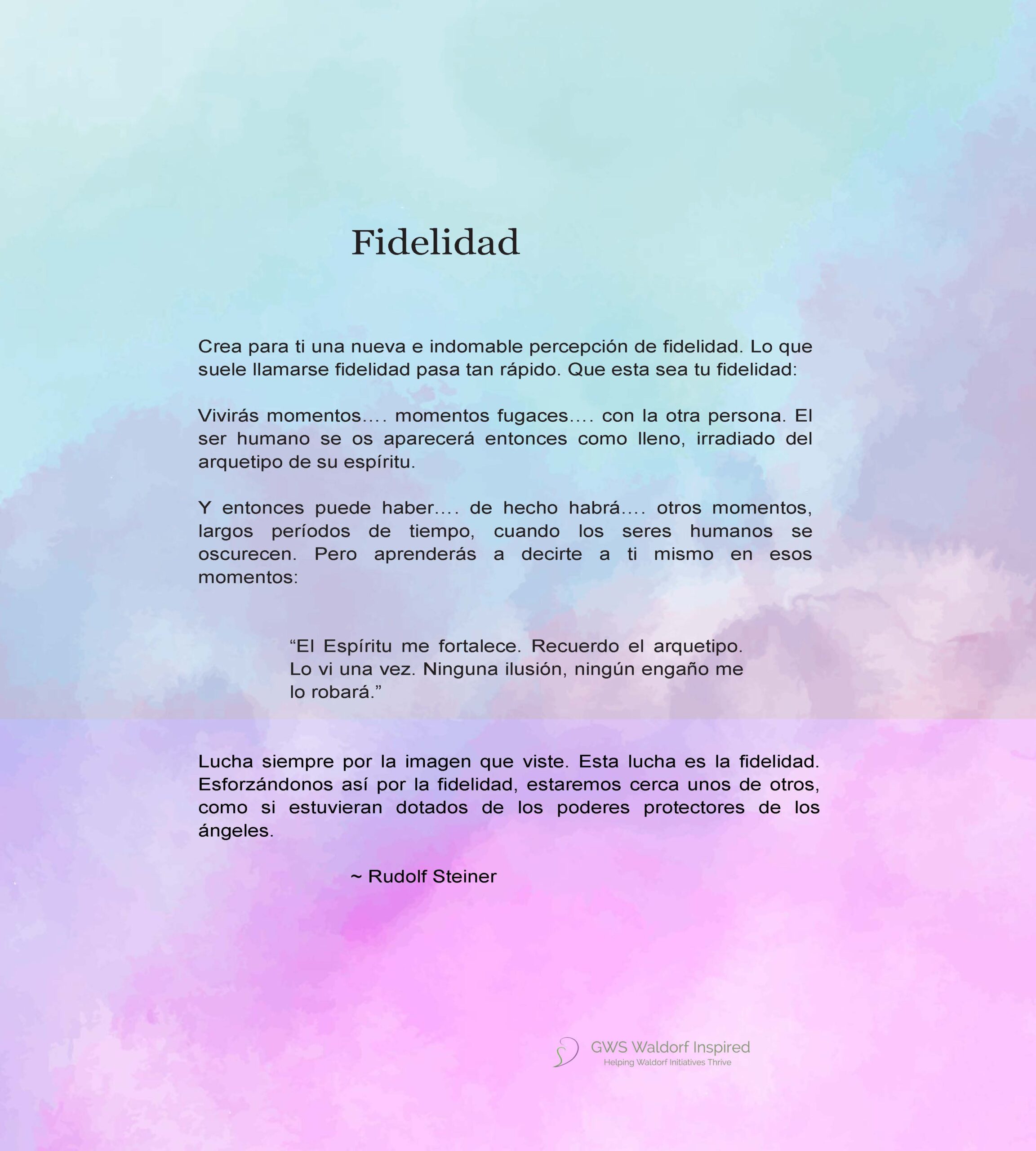
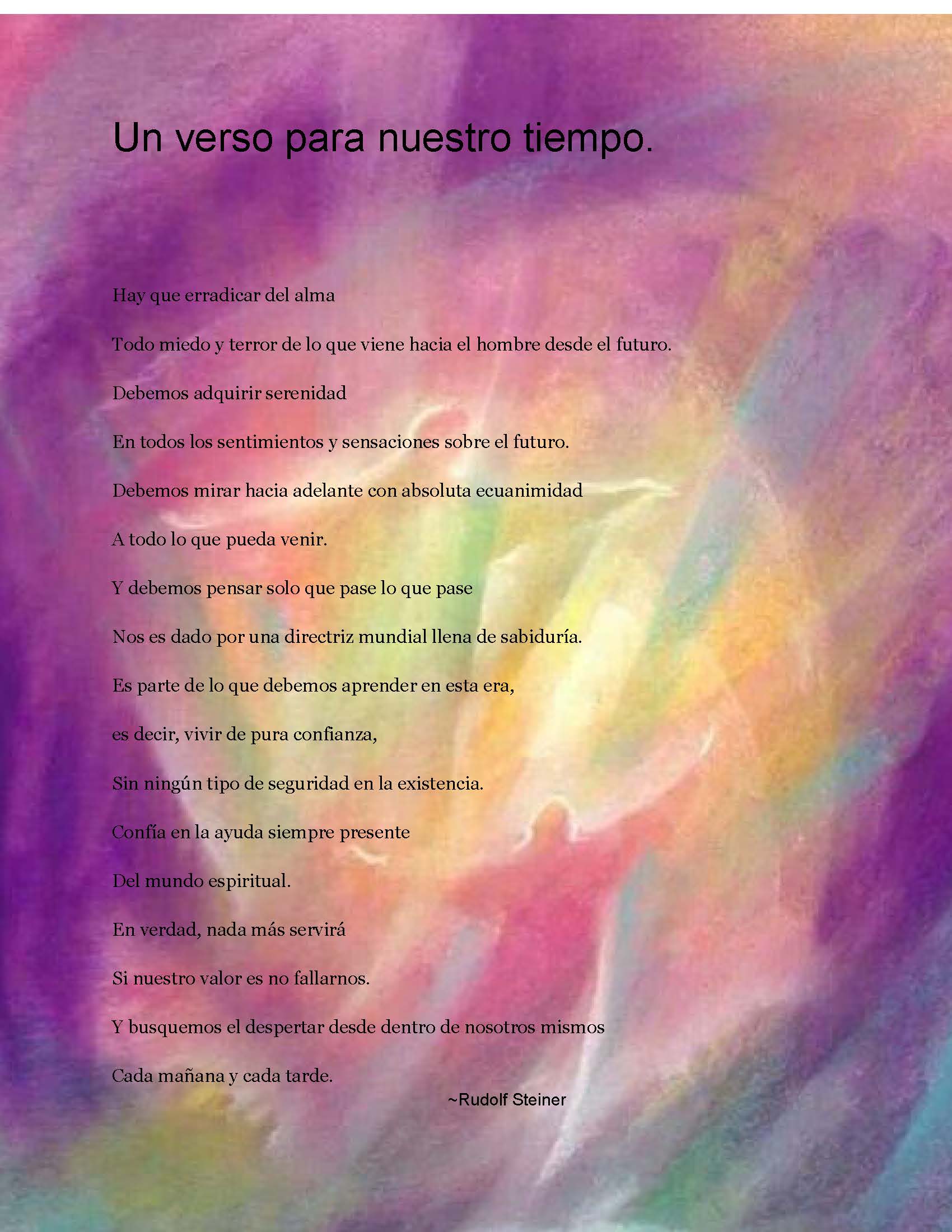
Steiner Verses

Verso en Español

Verso en Español

  • Disclosure: These verses have been shared by different unknown sources. We give credit to anyone who posted them originally from Rudolf Steiner lectures. “Faithfulness” art was created by GWS Inspired and “A verse of our time” was created by an unknown source.

Martinmas, Shine your light

Martinmas is one of the most beloved festivals celebrated for many centuries around the world. On this special day, November 11th, is the feast of Saint Martin, where in Waldorf Schools we turn our thoughts and faith to Saint Martin of Tours. Martin was a Roman soldier born in Hungary. He was the son of an army veteran who moved with his family to Italy early on. At the age of 15 he was already wearing a military uniform. For more than 15 centuries he has been remembered due to his actions while he was a young man serving in the Roman Empire military in Gaul (now Amiens-France).

In many cities around the world, the Saint Martin story is told around the second week of November and he is venerated for his actions of compassion and care for the less privileged. The story tells:

“One very cold winter’s day, Martin was riding his horse with his troop and on the way he met a beggar on the road who was shivering cold and half dressed. The troops that were riding with him passed the poor man but Martin stopped, and as he had nothing else to give the man to provide warmth, took out his sword and divided his mantle in two, and gave half to the beggar. That night he saw in a dream that Jesus Christ appeared to him dressed in the half mantle that he had given to the poor man and he heard him say: “Martin, today you covered me with your mantle.”

This week of November we remember Saint Martin and his brilliant light. The date of Martinmas coincides with Veterans Day in the United States which came from Armistice Day. 11/11 was the day WWI ended, a significant day of peace. In numerology, 11 is a magic number. Hence, we can create some of this light coming out of darkness for the children by making paper lanterns or any other creative material lantern and carrying our little light into the darkness making our own magic and awe for the young child.

As we near this day, we have the opportunity to experience our own interior light in the middle of the darkness. In places such as the ones in the Northern latitude in North America this darkness is getting more pronounced as we approach winter. In tropical places, such as countries in Central and some in South America, the rain is still lingering but soon the light will be stronger. To offer our light and share it with others is a spiritual will, proper of this celebration. We welcome you to join in and bring that light on a walk at night around your garden or a place that you treasure, as recognition and love to nature and our surroundings, where we turn for silence and comfort.

Songs and Poems in Martinmas:

I go outside with my lantern                                               Yo voy con mi farolillo   

I go outside with my lantern                                                  Yo voy con mi farolillo          

My lantern goes with me                                                          y mi farolillo conmigo

Above the stars are shining bright                                     arriba brillan las estrellas

Down here on earth shine we                                                y abajo brillamos nosotros

So shine your light through the still dark night            y si hace frío nos vamos a casa

Labimmel labammel la boom                                                  con nuestro pequeño farol

My lantern                                                                                      Farol

My lantern, my lantern                                                             Farol, farol

Sun and moon and stars                                                          Estrella, luna y sol

Put out all your light                                                                 Se apaga la luz

Put out all your light                                                                 Se apaga la luz

That my lantern can truly shine bright                          menos la de mi farol

Arde lucecita

Arde lucecita, iluminanos, proteger te quiero con todo mi amor

Saint Martin

Saint Martin, saint Martin, 

saint Martin rode through wind and snow 

on his strong horse his heart aglow.

He rode so boldly through the storm

His large cloak kept him well and warm.

By the roadside, by the roadside,

By the roadside a poor man arose,

Out of the snow in tattered clothes:

“I beg you help me in my plight,

or else I’ll die of cold tonight.”

Saint Martin, saint Martin, 

saint Martin stopped his horse and drew

his sword and cut his cloak in two.

One half to the beggar-man he gave

And by this deed his life did save.

Day of The Cultures – Oct 12

October 12, Cultures’ Day, is a the day of heritage and culture embraced in many parts of the world. It is a celebration in many Waldorf schools, especially in American schools. Before sharing how we celebrate this day in schools, it is worth mentioning as part of history how the recognition of this day originated and its name change.

Name Origin

The different countries in America and Europe have renamed the originally celebration of Columbus Day to different names, the first one being “The day of the Race (Dia de la Raza)”. However, throughout the past 100 years, this celebration has adopted many different names. 

The celebration of Columbus Day as the discovery of America was considered inaccurate. The commemoration of this event in history was celebrating the American resistance and the converging of cultures. The message of the discovery of America by a ruthless colonial oppressor or conqueror who enslaved the indigenous people was not pleasing. Several States in the US have toppled Columbus’ statues, including Virginia, Maryland and Massachusetts. Columbus was far from a hero but his discovery was crucial in the merging of Europe and the Americas. Hence, Italians focus on his qualities of ingenuity, resilience and courage, still holding Columbus in high esteem. [Washington Post, Oct 2020] 

Other Names

Irrespective of the opinions about Columbus, the focus on the impact of this discovery in America and the exchange of culture around the world prevails. Several countries and states in the United States first adopted the name to “Dia de la Raza” or Day of Race. Many countries later renamed it since the term “race” may have sounded a bit harsh, offensive, or discriminatory. The new names given to this National Day of October 12th vary around the world. In Spain, the name of the holiday is “El día de la Hispanidad”, or Day of ‘Spanishness’. Its celebration began in 1892 as National Spain Day. [El Mundo, Oct 2022]

In Latin American countries, the names differ. To name a few: in Argentina “The Day of Respect for Cultural Diversity”; in Nicaragua and Venezuela “The Day of Indigenous Resistance”; in Chile “The Day of the Encounter Between Two Worlds”; and in Costa Rica “The Day of the Cultures”. Even though the names are different in several countries, the message is the same. It is a day of celebration of the birth of a new identity and the fusion of Europeans with indigenous people.

What is this celebration?

This celebration of cultures is meaningful and visible in many countries and communities that have diversity of nationalities and backgrounds. Hence the day of culture, as the name in Costa Rica, is very descriptive of a time to share and embrace each other’s origins.

In Waldorf schools, particularly at GWS in Costa Rica, children and teachers brought different cultural items to share. Children will show and tell during class or share with the entire school. These items ranged from a drawing, a map, an outfit, a song, a dance, or a delicious dish from their country. During this week, we would prepare the children singing or reciting poems with a clear message of welcoming and cherishing our community and fellow residents.

As a teacher in the primary grades, I made dishes that originated from Ecuador, Brazil, and Argentina which I enjoyed growing up. For instance, my students made in class Pan de Yuca, a favorite Ecuadorian snack accompanied with yogurt smoothies, and a favorite also in Brazil – “Pão de Queijo”. This is a simple recipe that makes a quick dish in a lesson to practice math and social skills. If you feel like bringing a dish from another country into your class or family recipes, I share here a couple of recipes that are sure to bring smiles to children as well as adults. I hope you have a wonderful time celebrating this week with your family or community. Enjoy!

Yuca Bread, Pan de Yuca or Pão de Queijo: https://waldorfinspired.org/pan-de-yuca-or-pao-de-queijo/

Beef Empanadas/Empanadas de Carne: https://waldorfinspired.org/beef-empanadas/